Interdepartmental drills have been conducted to assess Ireland’s reaction to natural gas shortages and online service disruptions, aiming to enhance the nation’s robustness. The evaluation of the simulated situation involving a nationwide web outage, known as Operation Puca, will be submitted to the authorities for review.
Game planning forms part of Ireland’s initiatives to boost its resilience along with enhanced collaboration among government departments, state bodies, and utility providers. Since early 2022, around the onset of Russia’s invasion of Ukraine in February, public officials have conducted an annual simulation focused on potential disruptions to energy supplies in Ireland.
In December, an imaginary situation was simulated wherein there was significant interference with natural gas supplies. This scenario affected both gas pipelines connecting Ireland to the United Kingdom, these connections being responsible for providing 80% of Ireland’s total gas consumption.
READ MORE: Casualties increase following nightclub ceiling collapse; renowned vocalist amongst the unaccounted for.
READ MORE: The Met Éireann assessment of the 'Beast from the East' hitting Ireland as the specific date for the weather shift was confirmed.
Over 80 individuals from various departments and state bodies gathered at the National Emergency Coordination Centre located on Kildare Street in Dublin city to simulate the scenario.
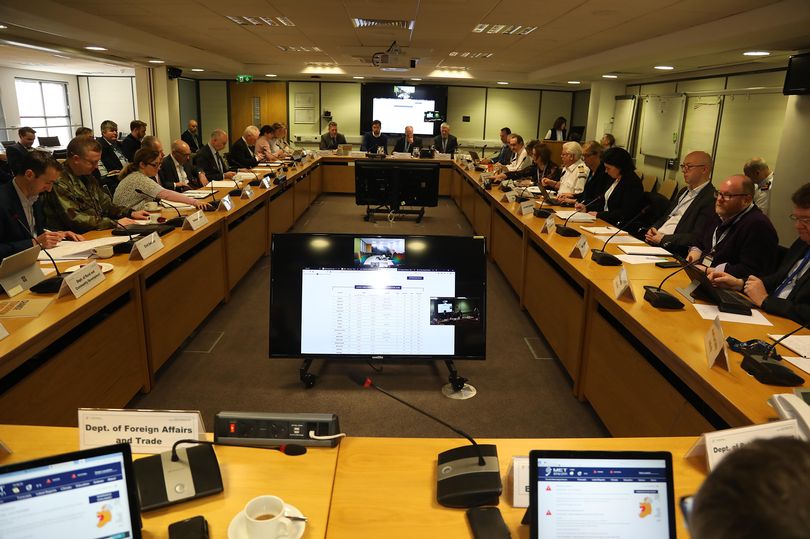
The topics covered included hospitals and airports, the significance of information, converting gas-powered stations to use oil instead, and determining priorities should energy supply be restricted.
John Burke from the Department of the Environment, Climate and Communications stated that Ireland is considered susceptible to significant gas disruptions due to the absence of a gas storage facility. In response, the Cabinet has approved the establishment of a floating LNG reserve.
In February, Exercise Puca took place, focusing on potential disruptions to internet access both within and outside the Irish mainland. The drill explored a "hybrid" scenario involving two issues: disruption of submarine communications along the western seaboard coupled with a cyber assault targeting cables situated on the eastern side.
The assessment of the proposed "combined" scenario will be submitted to the government. Following the events of September 11th in 2001, Ireland established an interdepartmental committee aimed at examining how international terrorism affects the country.
Following those initial developments, it evolved into an official entity known as the Government Task Force on Emergency Planning. This team has since analyzed various events such as the effects of climate change and floods, the eruption of the Icelandic volcano in 2010, Storm Emma in 2018, and the evacuation of Irish nationals from Kabul in 2021.
The chairperson is the Minister for Defence, and attendees include representatives from entities with decision-making authority such as Met Éireann, An Garda Síochána, and the Irish Coast Guard.
The National Emergency Coordination Group (NECG), serving as the active stage of the government’s task force, is led by the primary department responsible for managing the emergency.
The Office of Emergency Planning, which falls under the Department of Defence as a civilian-military division, focuses on coordinating matters related to strategic emergency management.
"It does not have the role of formulating the response procedures during crises. This duty falls under the jurisdiction of the primary governmental department," stated Kealan McMoreland, who heads the Office of Emergency Planning.
Keith Leonard, who serves as the national director for fire and emergency management, stated that the majority of emergencies are managed at a level "under NECG".
Generally, the kinds of situations (that the NECG responds to) include intense storms, extensive flooding, and extreme cold weather; we've likely experienced all three during the past winter.
He stated: "It is crucial that when we enter the National Emergency Coordination arena, every relevant government department and critical agency must be present, as this participation is required whenever such an emergency coordination meeting takes place."
Although a significant portion occurs within the digital realm, during rapid and intense meteorological events, we'll need various departments and agencies to be physically present, especially in the initial stages of the response.
Sign up for our newsletter to get the most recent updates from the Irish Mirror delivered straight to your mailbox: Sign up here.